The New Media Map: Where Smart Ad Budgets Go Next
The media map is being redrawn
Media planning used to be simple. Social created demand. Search caught intent. Display and online video filled in the gaps, and linear TV did the heavy lifting for brands with big budgets. The names on the invoices changed a little from year to year, but the shape of the plan stayed the same.
That shape is breaking. Two forces are pulling budget away from the classic media mix and toward a new set of channels that most media plans still treat as “test budget” line items.
Search is fragmenting. The Google search box is no longer the only place people look for answers. They ask chatbots, browse maps apps and dig through online communities, and each of those moments now has a paid layer. Ads inside ChatGPT went from launch to a billion-dollar run rate in roughly seven months, and Apple Maps started selling ads in August.
Commerce data is going everywhere. Retailers know what people actually buy, not just what they click. Amazon and Walmart have turned that knowledge into full-funnel ad businesses that reach far beyond their own websites, onto streaming TV, the open web and even the screens inside physical stores. Delivery apps, banks and travel brands are following the same playbook.
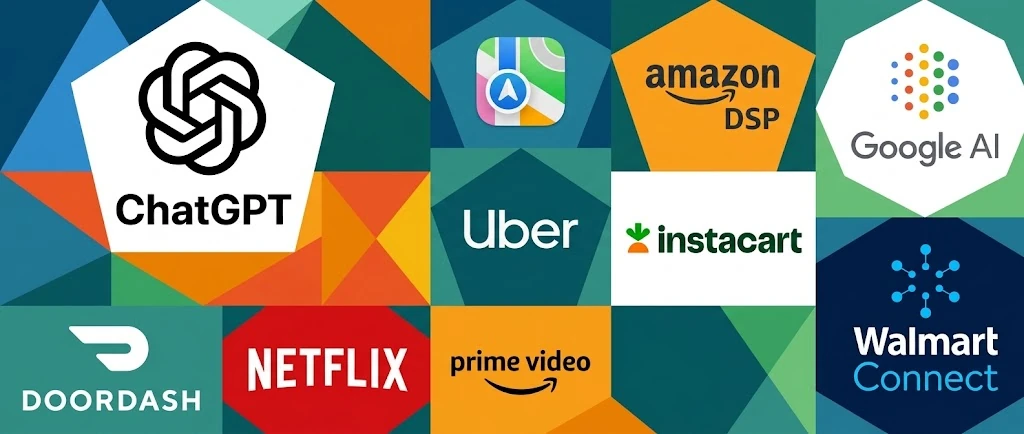
This guide is organized around those two shifts. Part 1 covers search: ChatGPT, Google AI Mode, Apple Maps and Reddit. Part 2 covers retail and commerce media: Amazon DSP, Walmart Connect, the delivery apps and the streaming inventory they sell. After that, we look at how these channels fit a digital marketing strategy across industries, and share a practical framework for testing any new channel without wasting budget. It’s the same playbook we use as a digital marketing agency when clients ask where their next dollar should go.
One caveat: these channels are moving fast. Minimum spends, ad formats, and country availability have changed several times in 2026 alone. Treat the specifics below as a snapshot as of October 2026, and check each platform’s current documentation before you build a plan around it.
Part 1: Search is fragmenting
For two decades, “search” meant typing keywords into Google. Today the same intent is spread across LLMs, maps apps and online communities. People ask ChatGPT for advice, open Apple Maps when they’re ready to visit, and add “reddit” to a query when they want real opinions. Each of those moments now has a paid layer, an organic layer, or both. A modern digital marketing strategy has to cover all of them.
ChatGPT: advertising inside the answer
ChatGPT is the fastest-growing new ad channel of 2026, and also the least proven. OpenAI published its ads principles on January 16, 2026 and began running paid ads in the US on February 9. By August 31, the company said ChatGPT Ads had passed a $1 billion annualized revenue run rate, was used by tens of thousands of advertisers, and was available in more than 40 countries.
How the ads work
ChatGPT ads appear as a clearly labeled sponsored card that sits beneath the AI’s answer, not inside it. OpenAI matches ads to the topic of the current conversation, and it has publicly committed that advertising does not influence the answers ChatGPT gives and that conversations are not shared with advertisers (and, as advertisers on the platform, we can confirm). Ads run only for users on the Free tier and the low-cost Go plan. Plus, Pro, Business, Enterprise and Edu users don’t see them, which requires deeper thought and strategy around audience alignment.
Targeting is contextual rather than keyword-based. Instead of bidding on “running shoes,” you’re effectively bidding on conversations about training for a first marathon. The intent signal is richer than a keyword, but it’s also harder to plan against, because there’s no keyword report showing exactly what people typed. A newer format lets brands share product feeds with OpenAI so relevant products can surface in shopping conversations.
What it costs
The price of entry has fallen fast. At launch, OpenAI priced ads at roughly a $60 CPM with commitments around $200,000. In April it launched a self-serve Ads Manager and cut the minimum to $50,000. In May, it added cost-per-click bidding, a measurement pixel and a Conversions API. Ad-tech partners have pushed entry costs lower still.
Why marketers are paying attention
ChatGPT is used by nearly three-quarters of the roughly 153 million US adults who use generative AI, and it accounts for about 70% of AI assistant traffic, according to figures EMARKETER compiled in June. Conversations also reveal intent in a way keywords rarely do. Someone who writes “I have a 12-year-old Honda with 150,000 miles, should I fix the transmission or buy something new?” has told you their budget pressure, timeline and decision stage in one message.
The caveats
Measurement is the weak point. Early advertisers got little beyond impressions. Click pricing, the pixel and a LiveRamp partnership are meant to fix that, but the tooling is months old. Trust is the other risk: a January 2026 Ipsos survey found 63% of US adults said ads in AI search results would make them trust the output less. And EMARKETER expects ads in AI chatbots to stay under $1 billion in total 2026 revenue, a rounding error next to search.
How to approach it
- Buy on clicks where you can. CPC pricing gives you something to compare against your search benchmarks.
- Craft careful copy. An ad under an answer competes with the answer. Lead with a specific, useful message, not a brand slogan.
- Invest in organic visibility. What ChatGPT says about your brand in its unpaid answers probably matters more than any ad today. Earned media clips feed LLMs as credible sources about your brand, making public relations efforts more important than ever.
- Treat it as learning budget. The goal of a test is to understand the audience and general performance, not to hit a scaled ROAS target. Learn from the campaign before deciding if the channel stays in the mix.
Google AI Mode: Google’s answer to the answer engine
ChatGPT isn’t the only answer engine selling ads. Google has been showing ads in AI Overviews for some time, and at Google Marketing Live in May 2026 it introduced new ad formats for AI Mode, its conversational search experience.
- Conversational Discovery ads use Gemini to write ad copy tailored to the user’s prompt, drawing on a brand’s own site and assets.
- Highlighted Answers place offers inside AI-generated recommendation lists.
- AI-powered Shopping ads add short explanations of why a product fits what the shopper asked for.
A tool called AI Brief lets advertisers emphasize or remove phrases in the AI-written copy. Google is also testing a Business Agent for Leads, which lets people ask a brand’s AI agent questions directly in search.
The practical difference from ChatGPT is access. You don’t buy AI Mode as a separate channel. Eligibility runs through Performance Max, AI Max for Search, Shopping and broad match campaigns you may already be running. That makes it easy to start but hard to isolate. If you want to know how AI Mode performs, push for placement-level reporting and watch your search term data closely. And because Gemini writes the ad from your materials, clean product data and clear site content matter more than ever.
Apple Maps: paid placement at the moment of the visit
Apple Maps is the most local channel on this list, and for businesses with physical locations it may be the easiest win. After thirteen years without ads, Apple Maps began showing sponsored listings to iPhone and iPad users in the US and Canada in late August 2026, with the rollout ramping through the following weeks.
The move had been coming for a while. Apple rebranded “Apple Search Ads” to simply “Apple Ads” in April 2025, a clear sign it planned to sell inventory beyond the App Store. In March 2026 it announced Apple Business, a single platform that replaced Business Connect, Business Manager and Business Essentials, and confirmed Maps ads would be part of it. Adweek reported that Apple’s ad business was on pace for about $8.5 billion in 2026.
How the ads work
There are two placements. Before someone types anything, a sponsored business can appear at the top of Suggested Places. After they search, a relevant sponsored listing can appear at the top of the results, with only one ad per search. The ads look like ordinary listings with a small blue “Ad” badge, and users can’t turn them off.
Advertisers bid in an auction and pay for outcomes such as views or taps. Any business with a physical location and a claimed Apple Maps listing is eligible. Campaigns can be built through Apple Business with largely automated creative, or through Apple Ads for more control over scheduling and geo-targeting. Apple also offered an introductory 15% credit toward future spend, on up to $1,000 a month during the first year.
Privacy is the defining difference from Google Maps. Apple says a user’s location and ad interactions aren’t tied to their Apple Account, and no data is shared with third parties. Targeting relies on the search, approximate location and map view, not a behavioral profile. Some categories are off limits: home services, bail bonds and crypto ATMs can’t advertise in Maps, and medical services are reviewed case by case.
Why it matters
Every iPhone ships with Apple Maps as the default, and Siri and CarPlay route through it. Local searches are some of the most commercially valuable there are. Someone searching “tire shop” or “sushi” is often deciding on their final destination in minutes. For restaurants, retailers, auto services, gyms, banks and hotels, Maps ads add a second local-search channel while auctions are still thin.
The caveats and how to approach it
The ad load is light by design, and reporting is limited by Apple’s privacy model.
- Audit your listings first. Claim every location in Apple Business and fix hours, categories, photos and phone numbers. The ad pulls from the listing.
- Start with visit-driven categories such as food, auto, retail and fitness.
- Measure with visits and calls. Use store-visit studies and call tracking rather than click attribution.
Reddit: where people search for real opinions
Reddit belongs in a conversation about search, not just social. It has become the place people go when they don’t trust polished marketing content, and that behavior shows up in two ways.
People search Reddit directly. Many people add “reddit” to Google queries such as “best running shoes reddit” to find candid opinions from real users. Reddit has also built its own AI search, Reddit Answers, which summarizes community discussions in response to questions.
AI answers draw on Reddit. Both Google and OpenAI have struck data deals with Reddit, and AI tools frequently cite Reddit threads when recommending products or services — on Google, Reddit content accounts for over 21% of all AI Overview citations. A thread comparing three brands of mattresses, or describing a bad experience with a local contractor, can shape what an answer engine tells the next person who asks.
That makes Reddit an organic visibility priority first. Monitor the communities where your category is discussed, answer questions honestly from a clearly identified brand account, and fix real problems people raise. Heavy-handed promotion backfires quickly — Reddit users are quick to call it out.
Paid ads come second. Reddit’s ad products work more like social ads than search ads, but they let you reach people mid-research by targeting specific communities and conversation topics. Promoted posts that read like genuinely useful contributions tend to perform best. For considered purchases, such as tech, finance, travel, healthcare and home services, Reddit ads are a sensible way to show up where people are already comparing options.
Part 2: Commerce data is going everywhere
Retail media started as sponsored product listings on a retailer’s own website, evolved into screens at the point of sale, and has since become something much bigger. Companies that know what people actually buy, such as retailers, delivery apps, banks and travel brands, now sell ads against that data across streaming TV, the internet, and other digital placements. The broader term for this is commerce media, and in an IAB survey, advertisers rated it as essential to their plans as often as they rated connected TV.
Two platforms lead the category, and a growing group of challengers is close behind.
Amazon DSP: shopper data, pointed at the whole internet
The Amazon DSP is no longer just a way to retarget people who looked at your product on Amazon. It has become one of the most important programmatic buying platforms in the market, especially for connected TV. Spend on Amazon DSP grew 67% year over year in Q2 2026, up from 41% in Q1, according to Tinuiti’s Q2 2026 benchmark report, which covers more than $4 billion in managed spend. Amazon’s total ad revenue hit $21.3 billion in Q4 2025, up 22%.
A demand-side platform lets you buy ads across many publishers from one place. Amazon’s is different because of the data behind it; it leverages signals from hundreds of millions of shopping, streaming and device interactions, plus the ability to tie ad exposure back to purchases. Three moves in the past two years turned it into a mainstream media platform.
- Prime Video ads. Making ads the default on Prime Video in 2024 gave Amazon one of the largest ad-supported streaming audiences in the US overnight.
- Roku. An exclusive 2025 deal lets Amazon DSP recognize logged-in viewers across Roku and Fire TV, reaching an estimated 80 million US connected TV households, more than 80% of the total. Roku said early users reached 40% more unique viewers on the same budget while cutting ad frequency by nearly 30%.
- Netflix. Since Q4 2025, advertisers can buy Netflix’s ad-supported inventory through Amazon DSP in about a dozen countries. Amazon’s discounted fees on third-party streaming inventory mean it can sometimes be cheaper to buy Netflix this way than directly.
The pitch is commerce data meets TV-scale reach. You can build an audience of people who bought a competing product in the last 90 days, show them a Netflix or Prime Video spot, follow up with retargeting, and measure the result in sales. For brands that sell on Amazon, closed-loop reporting connects ads to purchases and new-to-brand customers. For brands that don’t, Amazon Marketing Cloud, its clean room, lets you bring your own first-party data and measure against your own outcomes. That’s why cross-category advertisers now use Amazon DSP, even if their product is not sold on the platform.
Walmart Connect: the store, the screen and the shopping cart
If Amazon DSP is the most mature retail media platform, Walmart Connect is the fastest-growing serious challenger. Walmart’s global ad business reached nearly $6.4 billion in fiscal 2026 (February 2025 to January 2026), up 46%. In fiscal Q2 2027 (May to July 2026), Walmart Connect in the US grew 43% excluding Vizio, and global ad revenue grew 38%.
Walmart’s advantage is the store. Roughly 90% of Americans live within ten miles of a Walmart, and most of its sales still happen in physical locations. That lets Walmart Connect tie ads to in-store purchases, not just online, which matters most for grocery, household goods, health and beauty. The business now spans four layers:
- Onsite: sponsored search and display across Walmart.com and the app.
- In-store: digital screens at checkout, in aisles and at entrances.
- Connected TV: Walmart bought Vizio for $2.3 billion in 2024 and now sells its smart TV home screen and streaming inventory with Walmart shopper data. Vizio ad revenue grew at triple-digit rates in fiscal Q4 2026, and it lets Walmart sell to brands whose products aren’t sold at Walmart at all.
- Offsite: the Walmart DSP, built with The Trade Desk, buys across the open web and streaming using Walmart audiences.
In 2026, Walmart opened its data to more platforms and media. A Yahoo DSP and Magnite partnership marked the first time advertisers could use Walmart’s customer data outside the Walmart DSP. Advertisers can now reach Walmart audiences on Spotify and on live linear TV across Warner Bros. Discovery networks such as TBS, TLC and Food Network, all with closed-loop sales measurement. Walmart is also building ads into its Sparky shopping assistant, though it has said it will favor relevance over ad load.
Walmart also reaches a different shopper from Amazon: typically more suburban, more value-focused, and increasingly higher-income as wealthier households trade down.
Delivery apps: the newest billion-dollar ad businesses
Uber, DoorDash and Instacart have quietly become major ad platforms. Uber Advertising has passed a $2 billion annualized run rate. Instacart reported $286 million in advertising and other revenue in Q1 2026 alone. In June, DoorDash merged its ad operations with Wolt and Deliveroo into one global commerce media platform with more than 400,000 advertisers. EMARKETER expects each of the three to top $1 billion in commerce media revenue this year.
These platforms reach people at the moment of a purchase decision, often with location and time-of-day context that traditional retailers lack. Uber can show an ad on the screen of a rider headed to the airport. Instacart’s Carrot Ads technology powers ads on more than 300 grocery retailers’ sites. For consumer packaged goods, restaurants, alcohol and local services, delivery media can work like a digital end cap.
Other commerce media networks
Almost every company with logged-in customers and transaction data now sells ads. Target (Roundel), Costco, Kroger, Home Depot, Best Buy and Ulta run retail media networks. Banks such as Chase sell ads against card-spending data, and travel brands including United, Marriott and Expedia sell against loyalty profiles.
Programmatic streaming, powered by retail data
Netflix, Disney+, Max, Peacock and Prime Video have all built ad tiers, and nearly all now sell through major DSPs rather than only through upfront deals. Netflix alone had more than 90 million ad-supported subscribers when it announced its Amazon partnership. Amazon and Walmart have become two of the most important ways to buy this inventory, because they pair premium TV with purchase data. For mid-sized brands that were priced out of premium TV, programmatic access, lower minimums and retail audiences make streaming a realistic channel for the first time.
Retail media: the caveats and how to approach it
The same strengths and weaknesses show up across every platform in this group.
Measurement is strongest inside the walled garden. Amazon can prove a sale on Amazon, Walmart a sale at Walmart, Instacart a sale through Instacart. Anything that happens elsewhere relies on modeled attribution or your own data. And every platform that sells the ads also grades them, so self-reported results deserve an independent check.
Fragmentation is real. Each network has its own audience definitions, attribution windows and reporting, which makes it hard to compare them or to avoid paying twice for the same customer.
Prices will rise. As more advertisers pile into the same streaming inventory and retail audiences, costs will climb. Several offerings, especially Walmart’s offsite and CTV partnerships, are still in alpha or beta.
With that in mind:
- Start with streaming reach. For most brands, the biggest new opportunity is Prime Video, Netflix, Roku and Vizio reach with retail audiences.
- Pick networks by where your customers buy. Amazon for online-heavy categories, Walmart for in-store and value shoppers, delivery apps for food, grocery and convenience.
- Bring your own data. Use clean rooms such as Amazon Marketing Cloud to match your CRM and conversion data, so you can measure outcomes that happen off-platform.
- Prove incrementality. Run a test before scaling. Retail audiences can look great partly because they were going to buy anyway — so conducting an isolated test first can prove results.
- Consider non-endemic plays. If you don’t sell at a retailer, its streaming and offsite audiences may still fit, such as an insurer targeting new homeowners or an auto brand targeting growing families.
Fitting emerging channels into your digital marketing strategy
A good digital marketing strategy starts with the customer journey, not the channel list. Instead of asking “should we be on ChatGPT?”, ask where your customers make decisions, then look at which new channels show up at those moments. Most journeys have three.
When they’re researching
Long, specific questions are where answer engines and communities shine. A homeowner asking what a new water heater should cost, a couple planning a weekend getaway and a parent comparing kid-friendly snack brands are all doing their homework in ChatGPT, Google AI Mode and Reddit. At this stage, organic visibility usually matters more than ads. Make sure your listings, reviews, product data and site content are accurate and actually answer the questions people ask. Paid tests make sense where each customer is valuable enough to justify early-stage costs, which is why home services and hospitality brands are often the first to try ChatGPT ads.
When they’re choosing
Once people are weighing options, familiarity and timing win. This is where retail media and streaming TV earn their place. Amazon DSP and Walmart Connect let you reach people who have shown real purchase signals, then reinforce your brand on Prime Video, Netflix, Roku or Vizio. For CPG brands, this is the core of a modern digital marketing strategy: reach recent buyers of a competing product, then measure whether they switched. In a digital marketing strategy for hospitality, a resort can reach likely travelers at home in its feeder markets weeks before they book. Home services brands can use retail signals, such as recent purchases of home improvement products or new-mover audiences, to reach homeowners before something breaks.
When they’re ready to act
The final step often happens on a phone, minutes before a visit or purchase. For hospitality, Apple Maps ads capture “near me” searches for restaurants, bars and attractions, and Uber can reach travelers on the way to the airport. For CPG, delivery apps such as Instacart and DoorDash reach people with their cart open, and Walmart’s in-store screens reach shoppers in the aisle. Whatever you sell, this stage is the easiest to measure, because the path from ad to sale is short.
Check the rules before you plan
Every new channel has its own ad policies, and they don’t always match what you’re used to on Google or Meta. Home services are barred from Apple Maps ads entirely. Casinos and gambling-related hospitality brands face restrictions or extra review on most platforms, including AI chatbots. CPG brands selling alcohol need to confirm age-targeting and category rules on each network before launch. Check each platform’s policies early, because a rejected category can reshape the whole plan.
How to test an emerging channel without wasting the budget
New channels fail in predictable ways. The budget is too small to read, the test runs too short, the success metric is whatever the platform reports, and nobody decides in advance what result would justify scaling. A simple framework avoids most of that.
- Set aside a fixed innovation budget. Many brands use something like 5% to 10% of total media for new channels. Make it a standing line item so tests don’t compete with proven channels every quarter.
- Pick one question per test. “Does ChatGPT drive incremental sign-ups at a cost we can live with?” is testable. Asking how the channel performs as a whole isn’t.
- Decide the success metric and threshold up front. Write down the result that would make you scale, hold or stop, before the first dollar is spent. Use your own business metrics, such as new customers, store visits or revenue, not just the platform’s numbers.
- Spend enough to read the result. A test that can’t reach statistical significance is just an expense. Ensure a proper testing budget to allow the platforms to truly run the campaign.
- Run long enough. Most new channels need six to twelve weeks: two to four weeks for the platform’s algorithms to learn, then a stable run period.
- Give creative its own test. A new channel often needs new creative. A sponsored card under an AI answer, a Maps listing and a Netflix spot all call for different approaches, so don’t judge a channel by repurposed assets alone.
- Document what you learn. Even a failed test teaches you about audiences, costs and creative. Share it widely so the next test starts smarter.
Creative for answer engines: your tagline isn’t enough
What is a tagline, in a channel like this? Traditionally it’s the short, memorable line that sums up a brand, like Nike’s “Just Do It” or Apple’s “Think Different.” Brand taglines still matter for TV and outdoor, but a sponsored card under a ChatGPT answer or an AI-generated Google ad needs more than a slogan. Someone asking a detailed question wants a specific, useful answer.
That changes how to write a tagline for emerging channels. Keep the brand line, but build supporting copy around concrete benefits, proof points and offers that an AI system can match to a real question. Many of the best tagline examples today pair a short brand promise with a plain-language explanation of who the product is for. Test both versions in every new channel, and let the data tell you which one earns the click.
Don’t forget organic visibility
The biggest shift in this list isn’t just on paid. As more discovery happens in AI answers, what those tools say about your brand when nobody is paying matters enormously. Keep your product feeds, reviews, structured data and site content accurate and easy for machines to read. Make sure your locations are claimed and correct on Apple, Google and the delivery apps. In an AI-first world, clean data is media.
This is also where public relations has changed the most — earned media efforts now shape the sources AI tools learn from. Answer engines lean on news coverage, expert quotes, review sites and community threads, so earned media directly influences what ChatGPT and Google AI Mode say about you. Modern PR services, such as placing data-driven stories, securing expert commentary and building authoritative links, now double as AI visibility work.
The reverse is true too. A wave of negative reviews or an old crisis story can surface in an AI answer long after it has dropped off page one of Google. Online reputation repair, which means responding to reviews, correcting inaccurate listings and publishing credible new content, protects every paid channel on this list.
The bottom line
The media map isn’t being replaced overnight. Search and social still carry heavy budgets, and they will for years. The edges of the map are where growth is happening. ChatGPT went from zero to a billion-dollar run rate in seven months. Apple has turned its default navigation app into a local ad channel. Amazon and Walmart are using purchase data to sell streaming TV, and delivery apps have each built billion-dollar ad businesses almost without anyone noticing.
None of these channels is a sure thing. Several are still in beta, measurement is uneven, and prices will rise as competition increases. That’s exactly why now is the time to test. The brands that learn how these channels work while auctions are thin and minimums are falling will have a real advantage when they reach full scale.
Start small, measure what matters to your business, and treat every test as a lesson. The marketers who win the next decade will be the ones who were willing to try the channels everyone else was still watching.
Ready to put these channels to work? Whether you’re mapping a testing strategy, launching your first paid media campaigns, building social and creative that fit new formats, earning the press coverage AI tools learn from, or tracking performance against real business goals, our team can help you find where your next dollar should go.
Recent Articles

Who Really Controls the Brand? Highlights from the Las Vegas Women’s Marketing Collective
Read More »

Discovery call
We can start right now. Simply complete a quick form and we’ll set up a discovery call to dive deep on your business needs.